
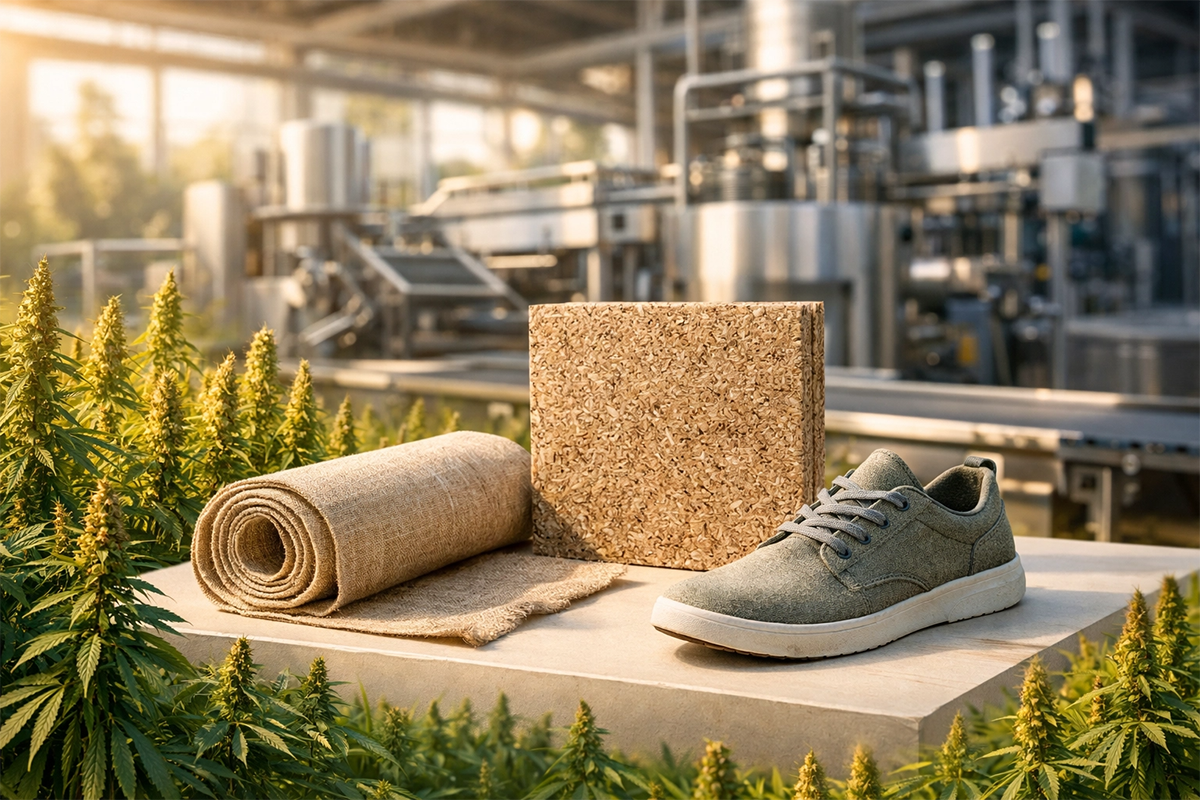
Industrial Hemp 101 —
From Field to Fabric,
Panel & Product
Everything you need to understand industrial hemp as a material — what it is, what it isn’t, how it’s grown and processed, where it performs well, and where it falls short. A no-hype foundation for engineers, builders, brands, and buyers.
What Is Industrial Hemp — and What It Isn’t
Industrial hemp is a variety of Cannabis sativa L. grown specifically for its fiber, seed, hurd, and biomass — not for its psychoactive properties. The critical legal and agronomic distinction is tetrahydrocannabinol (THC) content: industrial hemp varieties contain less than 0.2% THC in the EU and less than 0.3% in the USA, making them non-intoxicating and regulated differently from drug cannabis in most jurisdictions.
Hemp has been cultivated for industrial use for thousands of years — rope, sailcloth, paper, and structural materials all have deep histories with hemp fiber. The 20th-century prohibition of cannabis broadly suppressed industrial hemp cultivation across much of the Western world. Since the 1990s in Europe and 2018 in the USA (Farm Bill), legalisation of industrial hemp has led to significant investment in processing infrastructure and a growing body of applied research.
Industrial hemp vs CBD hemp: These are separate categories. CBD hemp is grown to maximise cannabinoid content, uses specific high-CBD varieties, and is harvested at a particular growth stage. Industrial hemp prioritises fiber yield, hurd yield, or seed production. HempFabrica covers only the industrial and material side — not CBD, wellness, or recreational products.
What makes hemp interesting to engineers, builders, and product teams is the combination of properties: fast-growing (70–120 days to harvest), high-yielding (more fiber per hectare than most crops), low-input (typically no pesticides required), and versatile enough to produce fiber, structural fill, insulation, and composite reinforcement from a single crop.
Hemp vs Drug Cannabis vs CBD Hemp — Understanding the Differences
All three are Cannabis sativa, but they are distinct in variety, growing practice, legal status, and intended use. Confusing them is one of the most common errors in hemp industry communications.
Industrial / Fibre Hemp
Varieties selected for fiber, hurd, or seed yield. Tall, fast-growing, dense-stalked plants. THC content below legal limits. Grown at scale in open fields, harvested mechanically.
CBD / Cannabinoid Hemp
Varieties selected for cannabidiol (CBD) and other cannabinoid content. Lower, bushier plants. Harvested at flowering stage for flower and extract. A different industry from fiber hemp.
Drug Cannabis (Marijuana)
High-THC varieties (10–35%+) selected for psychoactive properties. Different growing environment, harvesting, regulatory framework, and supply chain from industrial hemp entirely.
Parts of the Hemp Plant — What Each Part Produces
Industrial hemp is exceptional in that almost every part of the plant is commercially usable. Understanding which part produces which material is essential for correct specification and sourcing.
Bast Fiber (Outer Stalk)
The long, strong fibers from the outer part of the hemp stalk — the primary industrial fiber. Used in textiles, rope, composite reinforcement, nonwovens, and insulation batts. The highest-value fiber product from a fiber hemp crop.
Hemp Hurd (Shiv / Inner Core)
The woody inner core of the stalk after bast fiber has been separated. Used in hempcrete as the aggregate, loose-fill insulation, animal bedding, paper pulp, and as a substrate for growing media. High silica content slows natural degradation.
Hemp Seed
Used for human food (hemp hearts, hemp oil, protein powder), animal feed, and increasingly as a cosmetics and nutraceutical ingredient. Seed hemp varieties are selected for large seed yield rather than fiber. Seed harvest is mechanically separate from fiber harvest.
Biomass (Leaves & Stems)
Residual plant material after primary processing — usable in bioenergy production (combustion, anaerobic digestion), biochar, and as a soil amendment. Lower value per tonne but available in large volumes. Growing interest in hemp biomass for carbon sequestration accounting.
Processing sequence matters: What you get from a hemp crop depends heavily on the processing route chosen. Decortication separates bast fiber from hurd. Retting loosens fiber bundles. How thoroughly and gently retting is done affects fiber quality and length — which directly affects which end market the fiber can address. A crop processed for textiles-grade long fiber will have different economics and specifications than one destined for composite mats.
From Field to Finished Product — Five Stages
Understanding where value is added in the hemp supply chain helps you identify where to source, what questions to ask, and where the supply chain gaps currently are.
Cultivation
Licensed seed varieties, minimal inputs, 70–120 day growing cycle. Variety choice determines fiber vs grain vs dual-purpose output.
Harvest & Retting
Cutting, windrowing, and field retting (dew or water) to loosen fiber bundles. Retting quality determines fiber grade.
Decortication
Mechanical separation of bast fiber from hurd. Primary processing step — outputs two distinct product streams.
Secondary Processing
Hackling, carding, cottonisation for textiles. Pressing and binding for insulation. Mixing for hempcrete. Compounding for composites.
Finished Product
End-use products across construction, textiles, automotive, packaging, and consumer goods — each with its own certification and supply chain.
Supply chain gap: The weakest point in the hemp value chain in most Western markets is secondary processing infrastructure — particularly textile-grade retting and hackling facilities. Most European and North American hemp fiber is still sent to Asia for fine processing before returning as finished fabric. This adds cost, extends lead times, and reduces traceability. Investment in domestic secondary processing is the primary supply chain development priority in the UK, EU, and USA.
Industrial Hemp Sectors — Where the Material Goes
Hemp’s different material forms (bast fiber, hurd, seed, biomass) feed into distinct industrial sectors with different performance requirements, certifications, and supply chain needs.
Hempcrete, Insulation & Building Materials
Hemp hurd in lime binder as hempcrete wall infill. Hemp bast fiber in batts and rolls for insulation. Hemp boards for cladding panels and rigid insulation. One of the most commercially mature sectors.
Apparel, Workwear & Industrial Fabrics
Hemp bast fiber spun into yarn, woven into fabric, and used in blends with cotton, modal, or TENCEL. Covers everyday apparel, workwear, canvas goods, bags, and technical textiles.
Automotive Panels, Packaging & Goods
Hemp fiber as reinforcement in thermoplastic and thermoset matrices for automotive interior panels, consumer goods casings, marine equipment, and sporting goods.
Crop Rotation, Soil Health & Biomass
Hemp as a break crop in arable rotations for soil structure benefits, weed suppression, and phytoremediation. Fiber, grain, hurd, and biomass all represent market pathways for growers.
Moulded Packaging, Boards & Consumer Goods
Hemp pulp or hurd moulded into protective packaging inserts, food trays, and branded packaging. Hemp fiber compounded into bioplastics for injection-moulded consumer products.
Material Comparison Tool
Not sure which sector applies to you? Use our interactive comparison tool to see how hemp performs against conventional alternatives across nine key properties — filterable by sector.
Hemp’s Sustainability Profile — What the Evidence Shows
Hemp has genuine environmental advantages in several areas — and real limitations in others. Here’s an evidence-based assessment of where it leads and where it follows conventional materials.
Hemp’s Environmental Strengths
Where hemp consistently outperforms conventional alternatives
Limitations & Caveats
Where environmental claims require qualification or context
Greenwashing risk: Hemp’s environmental advantages are genuine but context-dependent — they depend on geography, processing route, and what the product is compared to. Absolute claims (“carbon negative,” “zero environmental impact,” “100% sustainable”) are almost always unverifiable for any manufactured product. For guidance on communicating hemp’s credentials without overstating them, see our Greenwashing Guide →
Legal Status of Industrial Hemp — By Region
Industrial hemp is legal to grow in most major markets — but the licensing requirements, THC thresholds, and permitted varieties differ significantly by jurisdiction.
Always verify current regulations in your jurisdiction before growing, processing, or importing hemp or hemp products. The regulatory landscape is evolving rapidly and local legal advice is essential for commercial operations. This guide provides general context only and is not legal advice.
Industrial Hemp Glossary — Key Terms Defined
The terminology used across hemp industries can be confusing — especially when the same word means different things in different sectors. Here are the key terms used throughout HempFabrica guides.
Industrial Hemp 101 — Common Questions
Can I grow hemp without a licence?
In most major jurisdictions — no. The EU, UK, USA, Canada, and Australia all require growing licences for industrial hemp, though the specific requirements differ significantly. Typically you need to use an approved variety from a licensed seed list, agree to field inspections, and operate within a registered cultivation plan.
Exception: In some jurisdictions, purchasing and processing already-harvested hemp (buying bales of straw or processed fiber) does not require a growing licence — only the cultivation itself does. Verify in your specific jurisdiction and consult a lawyer before proceeding commercially.
Is hemp stronger than cotton? Stronger than fibreglass?
Hemp bast fiber is approximately 30–40% stronger in tensile strength than cotton fiber — this is a consistent and well-documented finding. Hemp is not stronger than E-glass fiber (fiberglass) in absolute terms — glass fiber has significantly higher tensile strength. However, hemp fiber is approximately 42% less dense than glass, which means its specific stiffness (stiffness per unit weight) is broadly comparable to glass fiber. This makes hemp competitive for applications where lightweighting matters more than maximum strength.
How long does it take for hemp to grow?
Industrial hemp grows from seed to harvest in 70–120 days depending on variety, climate, and intended use. Fiber varieties are typically harvested earlier (before full seed maturity) for longer fiber quality. Seed varieties are left to full maturity. Hemp can grow 1.5–4 metres tall in a single season, which is part of what makes its fiber yield per hectare significantly higher than crops like cotton or flax.
Why did hemp get banned and when did it come back?
Industrial hemp was largely prohibited across the Western world through the mid-20th century as a collateral consequence of cannabis prohibition — despite being a different product with different uses. In most jurisdictions, industrial hemp was re-legalised or exempted from cannabis laws during the 1990s and 2000s in Europe, and in the USA with the 2018 Farm Bill. China never prohibited industrial hemp cultivation and remains the world’s largest producer and processor.
What’s the difference between hemp fiber and hemp insulation?
Hemp insulation (batts, rolls, loose-fill) is made from processed bast fiber — the same raw material as hemp textiles, just formed into a different product using thermal bonding or a small binder content. The fiber is opened, cleaned, and laid into a mat rather than spun into yarn. So the raw material is the same; the manufacturing process and end product are different. Hemp insulation is not made from hemp hurd — that’s hempcrete.
Is hemp genuinely carbon negative?
The crop itself sequesters significant biogenic carbon during growth — this is well-documented. Whether a hemp product is carbon negative depends on what happens after harvest: how it’s processed, transported, used in construction, and what happens at end of life. In hempcrete wall applications, published lifecycle analyses suggest net-negative embodied carbon is achievable over a building’s lifetime when the lime carbonation and biogenic carbon sequestration are both credited. For hemp insulation or textiles, the carbon balance is lower-carbon than alternatives but less likely to be net-negative when full lifecycle processing is included. The claim needs to be product-specific and supported by an LCA with clear system boundaries.
Ready to Go Deeper? Choose Your Sector
Hemp 101 gives you the foundation — now follow the guide that matches your industry or application.
Construction
Hempcrete, insulation, renders, and panels — full specification data for builders, architects, and specifiers.
Textiles & Clothing
Hemp apparel, workwear, canvas, and technical fabrics — what the performance data actually shows.
Composites & Bioplastics
Automotive panels, packaging, marine, and consumer goods — mechanical data and processing routes.
Getting Serious About Hemp in Your Industry?
Download our free evaluation checklist or use the material comparison tool to start your specification process.
Content Disclosure: HempFabrica is an independent, reader-supported resource. Some links may be affiliate or partner links. Data in this guide is drawn from published technical literature, industry research, and regulatory sources. It is provided for general information purposes only — not as legal, agricultural, or engineering advice. Verify regulatory requirements in your jurisdiction before commencing any hemp-related commercial activity. Last reviewed 2026.