
Hemp Insulation:
Batts, Rolls &
Loose-fill — Industrial Guide
A specification-grade guide to hemp fiber insulation across all building applications — thermal performance, moisture behaviour, acoustic data, product types, correct installation, and honest comparisons against mineral wool, cellulose, and rigid foam. Built for installers, specifiers, and builders.
Hemp Fiber Insulation — More Than Just a Green Alternative
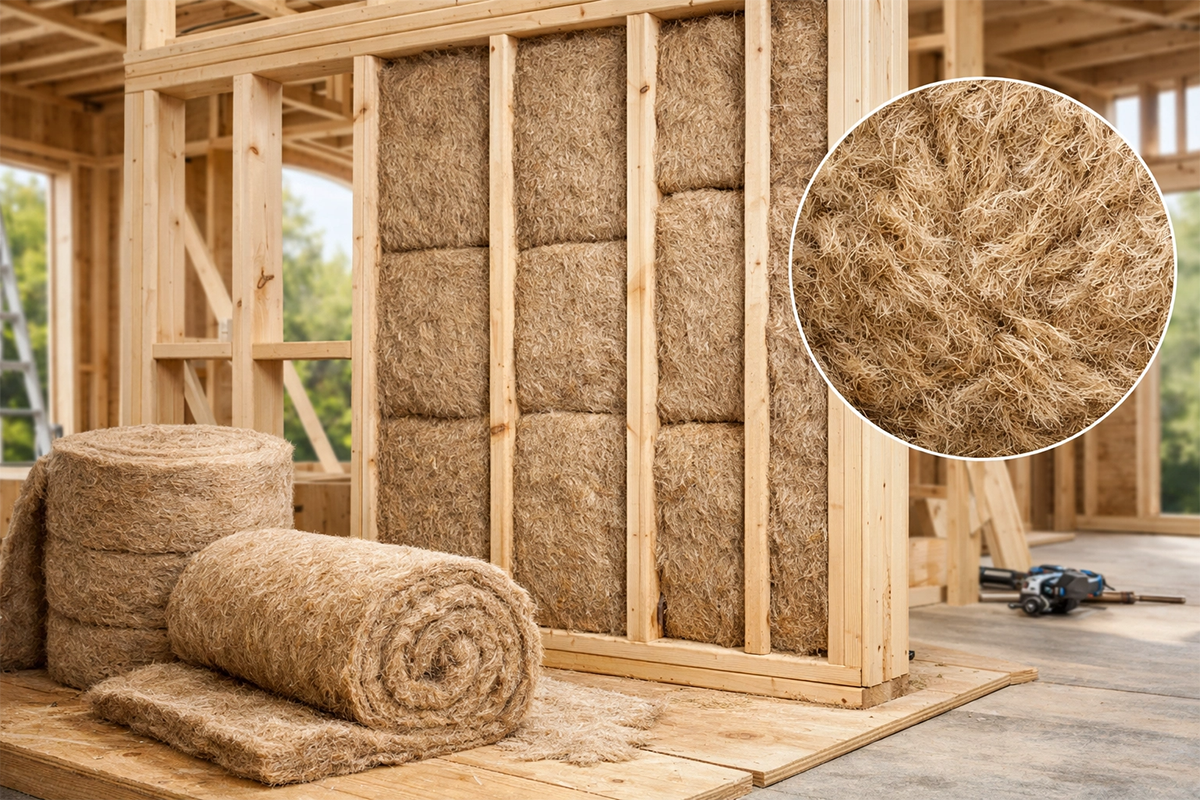
Hemp fiber insulation is made from processed bast fiber — the long outer strands from the hemp stalk — formed into flexible batts, rolls, and loose-fill. Most products include a small proportion of recycled polyester (15–20%) or natural latex as a thermally-bonded binder to hold the mat together; some use wool blends.
Thermally, hemp insulation performs in the same class as glass and rock mineral wool — λ values of 0.038–0.042 W/m·K put it directly in the mainstream insulation bracket. Where hemp diverges from mineral wool is in its moisture behaviour, handling characteristics, and embodied carbon. These three factors explain why it commands a price premium and attracts professional specifiers who understand building physics beyond headline R-values.
The moisture advantage: Hemp can absorb up to 20% of its own weight in moisture vapour and release it without structural degradation or meaningful loss of thermal performance. Glass mineral wool absorbs moisture too — but loses thermal performance significantly when wet and can hold water in a way that encourages mould in adjacent structure.
Installation is straightforward: hemp batts are cut with a knife or scissors, fit friction-tight between standard studs and rafters, require no PPE (no irritant fibres), and handle like a natural material — not an industrial chemical. For installers and self-builders this practical difference is significant.
Hemp Insulation Product Types — Batts, Rolls, Loose-fill & Boards
Four distinct product forms, each suited to different applications. Choosing the right form for the assembly is as important as the thermal specification.
Hemp Fiber Batts
Pre-cut slabs in standard widths (380mm, 570mm, 600mm) for friction-fit installation between timber studs and rafters. The most widely specified form. Slightly oversized by 5–10mm for a draught-free fit. Cut with a serrated knife or scissors.
Hemp Fiber Rolls
Continuous roll form for longer runs, sloped roofs, and applications where batts would require excessive cutting. More flexible than batts, slightly lower density. Useful for irregular-spacing applications and for covering large floor void areas efficiently.
Hemp Loose-fill
Chopped hemp fiber for blown-in applications — attic floor top-up, cavity fill, and accessible loft insulation. Applied by hand or blowing machine. Settles slightly over time; account for 10–15% settling in specification. Good for retrofit where access is limited.
Hemp Fiber Insulation Boards
Compressed hemp fiber formed into rigid or semi-rigid boards for external wall insulation, sarking boards, and flat roof insulation. Higher density than batts. Some products CE-marked for specific building applications. Check compressive strength for flat roof use.
Hemp-Wool Blended Batts
Hemp fiber blended with sheep’s wool (typically 50/50 or 60/40 hemp-led) for enhanced moisture management and handling. Wool adds natural fire resistance and anti-pest properties. Premium priced but lower borate treatment requirement in some products.
Dense Hemp Acoustic Batts
Higher-density hemp batts (50–80 kg/m³) specifically formulated for acoustic applications — party walls, floor/ceiling assemblies, recording studios, and commercial interiors. Excellent mid-to-high frequency absorption with good impact sound reduction when combined with decoupled framing.
Thermal Performance — λ Values & Real-World Behaviour
The headline figures and what they mean in practice. Hemp insulation’s thermal performance is competitive — understanding where it leads and where it follows matters for correct specification.
Thermal Conductivity — λ Comparison
Lower λ = better insulator (W/m·K, design values)
Embodied Carbon Comparison
kgCO₂e per m² at 100mm thickness (indicative)
The λ context: Hemp and mineral wool perform in the same thermal band. Hemp is not significantly better or worse than glass mineral wool on headline λ values. The meaningful performance difference is in moisture management, embodied carbon, and health & safety during installation — not thermal conductivity.
Moisture Buffering & Vapour Permeability
Hemp’s most significant functional advantage over glass mineral wool is its moisture behaviour. Hemp fiber can absorb up to 20% of its own weight in moisture vapour from the surrounding air — and release it again as conditions change — without structural degradation, without losing meaningful thermal performance, and without creating conditions for mould growth in adjacent timber or masonry.
Glass mineral wool also absorbs moisture but performs very differently: when wet, glass wool loses thermal performance significantly, can hold water in the lower layers of a cavity, and does not buffer humidity — it simply gets wet. Hemp’s natural hygroscopic properties make it genuinely superior for moisture management in breathable assemblies.
- Vapour permeability (µ = 1–3) Highly breathable — ideal for use in vapour-open assemblies where moisture needs to pass freely through the insulation layer without restriction.
- Does not rot or degrade when damp Hemp fiber retains its structure when exposed to moisture. Unlike glass fiber which collapses when waterlogged, hemp rebounds on drying.
- No vapour control layer required in many assemblies Breathable assemblies using hemp insulation can often use a vapour-open membrane rather than a vapour control layer — check with a building physicist for the specific assembly.
- Natural humidity regulation Hemp insulation in a room contributes to humidity buffering — absorbing excess moisture when humidity is high and releasing it when conditions dry — beneficial for indoor air quality.
Design warning: While hemp tolerates moisture better than glass mineral wool, it should not be permanently saturated. If there is a persistent water ingress problem in the building fabric, address the source first. Hemp insulation is not a substitute for correct weatherproofing and detailing.
Moisture Performance Comparison
Hemp vs glass mineral wool — key hygric properties
Hemp Insulation for Acoustic Applications
Hemp fiber insulation has excellent acoustic absorption properties — particularly at mid-to-high frequencies. The fibrous, open structure provides a natural mechanism for sound energy dissipation. Dense hemp batts (50–80 kg/m³) are used in party wall, floor/ceiling, and recording studio applications where both airborne and impact sound performance are required.
It is important to distinguish between sound absorption (how much sound a material absorbs) and sound insulation (how much sound transmission is blocked between spaces). Hemp insulation contributes to both, but assembly design — particularly decoupling, mass, and airtightness — dominates the overall performance of a partition or floor/ceiling build-up.
- NRC 0.75–0.95 Noise Reduction Coefficient at typical densities — comparable to acoustic mineral wool. Best performance at mid and high frequencies (500 Hz+).
- Party walls Dense hemp batts in decoupled stud walls (e.g. twin stud or resilient bar) contribute to Part E compliance in UK residential and equivalent regulations in EU jurisdictions.
- Floor/ceiling assemblies Hemp batts between floor joists provide acoustic mass and absorption — effective when combined with a resilient ceiling layer below and floating floor above.
- Low-frequency limitation Like all fibrous insulation, hemp has limited performance at low frequencies (below ~200 Hz). For bass-heavy applications (home cinema, recording studios), additional mass and decoupling are essential regardless of insulation choice.
Acoustic Performance at a Glance
Hemp fiber insulation — sound absorption by frequency
Hemp Insulation by Application — Roofs, Walls, Floors & More
Each application context has different thermal, structural, and moisture requirements. This guide covers the main use cases and what to consider for each.
Pitched Roof — Between & Below Rafter
One of hemp insulation’s strongest applications. Hemp’s moisture tolerance is highly relevant at rafter level where thermal bridging, condensation risk, and vapour management are all live concerns. Two-layer system (between and below rafter) achieves low U-values while maintaining a breathable assembly.
Loft Floor — Accessible Attic
The simplest hemp insulation application. Rolls or batts laid cross-ways in two layers (100mm between joists + 100mm over). Excellent for retrofit — easy to install, no irritant fibres, and significantly better moisture behaviour than glass mineral wool in older, unventilated loft spaces.
Timber Frame Stud Walls
Hemp batts friction-fit between studs in new-build and retrofit timber frame walls. Works in both vapour-open and controlled-vapour assemblies. Particularly good for heritage and renovation projects where a breathable wall system is specified. No PPE required — significant installer comfort advantage.
Solid Wall Internal Retrofit
Hemp fiber boards or batts fixed to the internal face of solid masonry walls as part of an internal wall insulation (IWI) system. Breathable system essential — impermeable insulation systems on solid walls are a known cause of damp problems. Hemp’s high µ (1–3) makes it appropriate for this high-risk application.
Suspended Timber Ground Floor
Hemp rolls or batts between floor joists in suspended timber ground floors. Moisture tolerance is a specific advantage here — ground floor voids are often humid, and glass mineral wool absorbs moisture readily in this location. Hemp’s resilience to moisture cycling makes it a reliable choice for this application.
Party Wall & Floor/Ceiling Acoustic
Dense hemp batts (50–80 kg/m³) in decoupled party wall assemblies and floor/ceiling build-ups for airborne and impact sound reduction. Works best in combination with decoupled framing (twin stud, resilient bar) and adequate mass. Comparable performance to acoustic mineral wool products.
Hemp Insulation Thickness Guide — Target U-values
Indicative thickness ranges to achieve common U-value targets for UK and EU climate zones. Always model the full assembly in software for accurate U-value calculations — thermal bridging affects real performance significantly.
Hemp Batt Thickness to U-value — Pitched Roof Assembly
Between-rafter + counter-batten layer (λ = 0.039 W/m·K), excluding thermal bridging correction
Important: These figures are for the insulation layer only, not the full assembly U-value. Thermal bridges through timber studs, rafters, or other structural elements reduce real-world performance by 15–30% in typical timber frame construction. Use a thermal bridging correction factor (Ψ value) or full 2D modelling for compliant calculations.
Hemp Insulation Installation — Step by Step
Hemp batts and rolls are among the easiest insulation products to install — no PPE, no specialist equipment, and straightforward cutting. Here’s what on-site best practice looks like.
Measure and Order with Tolerances
Measure stud or rafter spacings before ordering — they rarely match nominal dimensions in older buildings. Order batts 10–15mm wider than the actual gap to ensure a draught-free friction fit. For irregular spacings, order roll form and cut to width on site.
- Account for variations in stud spacing across the wall or roof
- Add 10–15% to area calculations for wastage and offcuts
- Check that product width matches rafter or stud centres before delivery
No PPE Required — But Wear Sensible Clothing
Hemp insulation contains no irritant fibres — no gloves, dust mask, or eye protection are required for normal installation. This is a significant handling advantage over glass or rock mineral wool. That said, cutting generates some dust — sensible practice is to work in a ventilated area and avoid raising dust unnecessarily.
Cut with a Serrated Knife or Bread Knife
Hemp batts cut easily with a long serrated knife — a bread knife works well. Cut slightly oversized (5mm) to ensure tight fit. For precise acoustic applications, use a straight edge and score first before cutting through. Avoid compressing the batt during cutting.
- For cuts around obstacles, template first with cardboard
- Electric bread knives make volume cutting significantly faster
- Loose-fill can be cut or torn by hand
Friction-Fit — No Fixings Required
Batts are designed to friction-fit between structural members without adhesive or mechanical fixings. Push the batt in from one side, ensuring full contact with both structural members across the full depth. There should be no gaps at edges or around obstacles — gaps significantly reduce thermal and acoustic performance.
For floor/ceiling applications: In joist bays, batts will need support unless the depth is less than about 75mm. Use joist netting, wire mesh stapled between joists, or rigid board below to support the insulation.
Services, Penetrations & Thermal Bridging
Carefully fill around pipes, cables, and other penetrations with offcuts. Any gap around a service is a thermal bridge and a potential air leakage path. For electrical sockets in insulated walls, use back-boxes with foam seals or airtight boxes.
- Never compress batts to fit around obstacles — cut and fill properly
- Second layer batts should overlap joints in the layer below by at least 150mm
- At structural members (rafters, studs), consider counter-battening to reduce thermal bridging
Vapour Membrane Selection
Hemp insulation is highly breathable — use only vapour-open (high SD value) breather membranes on the cold side and vapour-open control layers on the warm side. Never use a fully impermeable vapour barrier with hemp insulation in a breathable assembly — it traps moisture in the insulation and creates the condensation risk the hemp was specified to avoid.
Always confirm the vapour membrane specification with a building physicist or energy assessor for the specific assembly and climate. What works in a mild maritime climate may not be appropriate elsewhere.
Hemp Insulation vs All Major Alternatives
A comprehensive comparison across the properties specifiers and installers actually care about. No insulation wins on every criterion — the question is which tradeoffs suit the project.
| Property | Hemp Fiber | Glass Mineral Wool | Rock Mineral Wool | Cellulose | Sheep’s Wool | EPS Foam |
|---|---|---|---|---|---|---|
| λ (W/m·K) | 0.038–0.040 | 0.033–0.044 | 0.033–0.040 | 0.040–0.042 | 0.038–0.040 | 0.031–0.038 |
| Embodied carbon | Very low ~1.2 | Moderate ~4.5 | Moderate ~5.1 | Low ~1.5 | Low ~1.8 | High ~7.2 |
| Moisture tolerance | Excellent | Poor (holds water) | Moderate | Good | Excellent | None (vapour closed) |
| Vapour permeability (µ) | 1–3 (open) | ~1 (open) | ~1 (open) | 2–3 (open) | 1–2 (open) | 20–100 (closed) |
| PPE required | None | Yes (irritant) | Yes (irritant) | Dust mask | None | None |
| Acoustic NRC | 0.75–0.95 | 0.80–0.95 | 0.80–0.95 | 0.70–0.90 | 0.75–0.90 | 0.05–0.20 |
| Biodegradable | Yes | No | No | Yes | Yes | No |
| Material cost vs glass wool | 30–80% higher | Benchmark | 10–30% higher | 20–50% higher | 60–120% higher | Competitive |
| UK/EU supply availability | Growing | Excellent | Excellent | Good | Moderate | Excellent |
Hemp Insulation — Genuine Strengths & Real Limitations
Hemp Insulation FAQ
The questions installers, self-builders, and specifiers ask most often.
Is hemp insulation treated with fire retardants?
Most hemp insulation products are treated with borate-based fire retardants and pest deterrents — this is standard practice across the industry and is the same approach used for cellulose insulation. Borates are considered low-toxicity compared to halogenated flame retardants used in some synthetic foams.
For chemical-sensitivity specifications: Some manufacturers offer untreated products — but these may require additional fire protection measures in the assembly design and may affect compliance with building regulations in some jurisdictions. Check with your supplier and building control body.
Can hemp insulation be used in a Passivhaus build?
Yes — hemp fiber insulation can be used in Passivhaus assemblies. The thermal conductivity (λ ~0.038–0.040 W/m·K) is compatible with Passivhaus U-value targets, though the thickness required will be greater than with PIR or phenolic foam. The key requirements are accurate PHPP thermal bridging modelling, careful airtightness detailing at every penetration and junction, and correct vapour membrane selection for the specific assembly.
Hemp’s moisture buffering properties can be beneficial in Passivhaus assemblies, particularly in timber frame construction where condensation risk at the warm side of the insulation is a concern. Consult a Certified Passivhaus Designer for the specific assembly specification.
Does hemp insulation have a Building Regulations CE mark or BBA certificate?
Some hemp insulation products have CE marking under EN 13162 (mineral wool) or the more directly applicable EN 16783 (plant fibre insulation products introduced in the EU in 2016). In the UK post-Brexit, products may carry a UKCA mark instead of CE, or be assessed through a British Board of Agrément (BBA) certificate. Always request the current product certificate from your supplier and confirm it applies to the specific application before specifying. Not all products on the market carry third-party certification — check before specifying on a building regulations-governed project.
How does hemp insulation compare to sheep’s wool?
Hemp and sheep’s wool are the closest competitors in the natural insulation market — both breathable, both moisture-tolerant, both biodegradable. Thermally they are broadly equivalent (λ 0.038–0.042 for both). Sheep’s wool has a slight edge on natural fire resistance and generally needs less or no borate treatment. Hemp tends to be lower cost per m² than wool and has a more consistent fiber quality. The two are also frequently blended together (hemp-wool batts) to combine the benefits of both. If cost is the primary driver, hemp usually wins. If fire performance and borate-free specification is the priority, wool may be preferred.
What is the lifespan of hemp insulation in a building?
Hemp fiber insulation, when correctly installed in a well-detailed assembly, should last the full life of the building — 50–100 years or more. The key condition is that the insulation remains dry — or more precisely, that any moisture it absorbs can be released. In a correctly designed breathable assembly, hemp insulation should perform indefinitely. The failure mode is persistent saturation: if the assembly detail fails and water is trapped against the hemp for extended periods, degradation will occur. This is a detailing problem, not a material problem.
Is hemp insulation more expensive than mineral wool? By how much?
Yes — hemp insulation is generally 30–80% more expensive than equivalent glass mineral wool on a material cost basis. As a rough UK guide (2025): standard glass mineral wool batts at 100mm cost approximately £4–8/m² installed, while hemp fiber batts at equivalent specification cost £8–14/m². The premium is real and significant on a whole-house scale.
The cost premium is most justified where moisture management matters (suspended timber floors, solid wall retrofit, heritage buildings), where embodied carbon targets are set, or where installer health and absence of PPE is a specified requirement. For straightforward new-build stud wall insulation where moisture risk is low, the cost premium requires a deliberate sustainability or health rationale.
Ready to Specify Hemp Insulation in Your Project?
Download our free evaluation checklist or explore related guides for context and wider sector comparisons.
Content Disclosure: HempFabrica is an independent, reader-supported resource. Some links may be affiliate or partner links. Performance data presented is drawn from published technical literature, manufacturer data sheets, and industry standards — values are indicative ranges and vary by specific product, density, and installation quality. Always obtain current product data sheets and seek independent professional advice for building regulations compliance and structural or thermal calculations. Last reviewed 2026.