
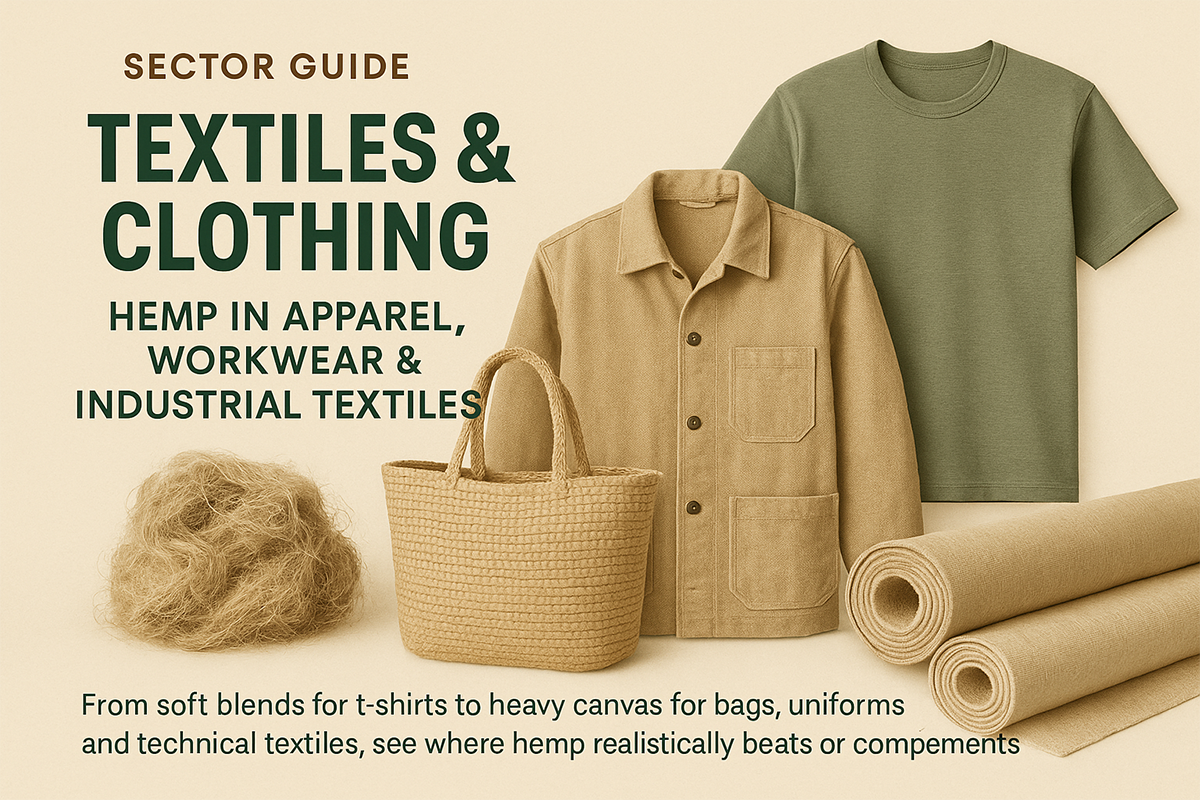
Hemp in Apparel,
Workwear & Industrial Textiles
From soft blends for everyday clothing to heavy-duty canvas for bags, uniforms, and technical fabrics — this guide explains where hemp textiles realistically beat, complement, or trail cotton and synthetic alternatives. Real specifications, honest performance data, and sourcing context for brands and buyers.
Industrial Hemp in Textiles — The Practical Picture
Industrial hemp bast fiber has been used in textiles for thousands of years — and is experiencing a genuine commercial revival as brands and manufacturers respond to water scarcity pressures, synthetic fiber regulation, and consumer demand for traceable, lower-impact materials.
The case for hemp in textiles is strongest in three areas: durability (hemp fiber is genuinely stronger than cotton, particularly when wet); environmental profile (lower water, no pesticides, faster growing cycle); and versatility (hemp can be processed into everything from fine jersey blends to industrial canvas).
The softness question: Raw hemp fiber is coarser than cotton. This has historically limited its adoption in premium apparel. Modern processing — retting improvements, cottonisation, and blending with cotton, TENCEL, or modal — has largely closed this gap. Hemp-cotton blends at 55/45 are now used in mainstream consumer garments with comparable handle to 100% cotton.
Where hemp underperforms is in supply chain maturity. Outside China (the world’s largest hemp textile producer), certified, traceable, EU- or US-grown hemp fabric supply chains are thin and often expensive. For brands that need volume and price consistency, this remains the primary barrier.
Hemp Textile Use Cases — Five Active Markets
From mainstream apparel to specialist industrial textiles — each use case has a different performance requirement, price sensitivity, and supply chain maturity.
Everyday Apparel & Fashion
T-shirts, shirts, dresses, trousers, and knitwear — most commonly as hemp-cotton or hemp-TENCEL blends. Growing mainstream adoption from lifestyle and outdoor brands. Improved softness from modern processing now comparable to mid-weight cotton.
Workwear, Uniforms & Light PPE
Hemp canvas and twill for work trousers, jackets, aprons, and uniforms where abrasion resistance and durability over repeated industrial washing are required. The performance case for hemp over cotton duck is clear — the barrier is CMT factory familiarity.
Bags, Packs & Canvas Goods
Tote bags, backpacks, duffel bags, and accessories using heavy hemp canvas. One of the earliest mainstream commercial uses of hemp fabric. Strong, abrasion resistant, takes natural dyeing well. Several major outdoor and lifestyle brands use hemp canvas in their bag ranges.
Industrial & Technical Fabrics
Hemp nonwovens, reinforcement fabrics, geotextiles, rope, and upholstery substrates where strength, weight, and natural fiber content are specified. Hemp’s high tensile strength makes it competitive with synthetic reinforcement materials in some applications.
Medical Textiles & Hygiene Products
Hemp’s natural antimicrobial and breathable properties make it relevant for wound dressings, bandages, medical gowns, and hygiene textiles. An emerging area — not yet mainstream — but growing interest from healthcare sustainability procurement.
Hemp Fabric Forms — From Yarn to Technical Nonwoven
Hemp fiber is processed into a wide range of fabric forms, each suited to different end uses. Choosing the right form for the application is as important as the fiber choice.
Hemp Yarn & Jersey Knits
Ring-spun or open-end hemp yarn, often blended with cotton or modal for improved softness and drape. Used in t-shirts, casual shirts, knitwear, and socks. Modern cottonised hemp yarn produces jersey fabrics comparable in handle to mid-weight cotton jersey.
Hemp Canvas & Twill Weaves
Heavy woven fabric in plain (canvas) or diagonal (twill) weave for workwear, bags, upholstery, and outdoor goods. The traditional use of hemp — and still its strongest performance category. Abrasion resistant, UV stable, stronger when wet than cotton equivalents.
Hemp Denim
Hemp fiber woven into denim-weight fabric — either 100% hemp or blended with organic cotton or recycled cotton. A growing segment of the sustainable fashion market. Slightly stiffer than cotton denim when new, but breaks in with wear. Several brands have successfully launched hemp denim ranges.
Hemp Nonwovens & Technical Fabrics
Needle-punched, thermal-bonded, or wetlaid nonwoven hemp mats for industrial applications — reinforcement layers, filtration, geotextiles, insulation facings, and automotive backing fabrics. The performance driver is strength and weight efficiency rather than aesthetics.
Hemp in Everyday Apparel & Fashion
Hemp apparel has moved from niche natural-fiber stores to mainstream lifestyle brands over the past decade. The shift has been driven by two things: improvements in fiber processing that have significantly improved handle and softness, and genuine consumer appetite for lower-impact fibers backed by specific, verifiable data.
Most hemp apparel today uses a blend rather than 100% hemp — typically 55% hemp / 45% organic cotton, or 55% hemp / 45% TENCEL. The blend provides the durability and environmental advantages of hemp with the softness and dyeability profile of the partner fiber.
- T-shirts & jersey tops 55/45 hemp-cotton or hemp-TENCEL. Weight 160–220 gsm. Comparable handle to equivalent cotton jersey after the first few washes. Better durability and odour resistance.
- Woven shirts & bottoms Lighter hemp weaves (140–200 gsm) in plain or poplin. Very breathable — a genuine performance advantage in hot climates or active use.
- Outerwear & jackets Heavier hemp canvas or hemp ripstop blends for jackets, overshirts, and outdoor garments. UV resistance is stronger than cotton — relevant for prolonged sun exposure.
- Activewear Emerging use — hemp-spandex or hemp-tencel blends for yoga, training, and outdoor active. Still developing, but properties (breathability, odour resistance, moisture management) align well with the category requirements.
Softness over time: Hemp fabric softens significantly with washing. Brands that communicate this upfront — “gets better with every wash” — turn a perceived limitation into a positive brand story. Brands that don’t communicate it get negative early reviews from customers expecting cotton softness from day one.
Hemp vs Cotton — Apparel Performance
Key properties relevant to garment specification
Hemp in Workwear, Uniforms & Industrial Clothing
Workwear is where hemp’s performance case is strongest. The properties that matter most in work clothing — abrasion resistance, durability, strength when wet, UV stability, and long wash life — are areas where hemp canvas consistently outperforms conventional cotton duck.
The primary barrier to wider workwear adoption isn’t performance — it’s CMT factory familiarity. Hemp canvas behaves slightly differently from cotton duck in sewing rooms (needle choice, tension settings), and many production facilities haven’t adapted. This creates lead time and minimum order challenges for brands entering the category.
- Work trousers & dungarees Hemp canvas or hemp-cotton twill (340–450 gsm). Superior abrasion at knees and pockets. Stronger when wet — significant for outdoor or damp environments.
- Jackets & overshirts Mid-weight hemp canvas (280–380 gsm) for field, construction, and trades applications. UV resistance is a practical benefit for outdoor workers.
- Aprons & protective layers Heavy hemp canvas (400–600 gsm) for kitchen, workshop, and garden aprons. Excellent durability, holds shape well, and ages attractively — relevant for premium workwear brands.
- Uniforms at scale Hemp-cotton blends for institutional uniforms where sustainability credentials are a procurement specification. Growing demand from hospitality, NHS, and corporate sustainability programmes.
Hemp Canvas vs Cotton Duck — Workwear
Key properties for workwear specification
Hemp Fiber Performance — Environmental & Physical Properties
The numbers behind hemp’s claims — environmental profile compared to conventional fibers, and physical performance data relevant to specification.
Environmental Performance vs Major Fibers
Relative performance — lower resource use = higher score
Fiber Yield & Physical Properties
Key agronomic and technical fiber metrics
Hemp vs Cotton, Polyester & Other Natural Fibers
A frank comparison across the properties that matter most to brands, buyers, and specifiers. Hemp excels on several criteria — and trails on others. Know which matters for your product.
| Property | Hemp | Conventional Cotton | Organic Cotton | Polyester | Linen (Flax) |
|---|---|---|---|---|---|
| Tensile strength | High (+30–40% vs cotton) | Moderate | Moderate | High | High |
| Water use (growing) | Very low | Very high | Moderate | None (synthetic) | Low |
| Pesticide requirement | None typical | Very high | None | None | Very low |
| Biodegradability | Yes — fully | Yes | Yes | No — microplastics | Yes |
| Softness (finished fabric) | Good (blended/processed) | Excellent | Excellent | Variable | Good (gets better) |
| Breathability | High | High | High | Low–moderate | Very high |
| UV resistance | Better than cotton | Moderate | Moderate | Good | Good |
| Material cost (fabric) | 20–50% premium | Benchmark | 20–40% premium | Low | 10–30% premium |
| Supply chain maturity | Developing | Fully mature | Good | Fully mature | Moderate |
Sourcing Hemp Textiles — What to Know
Where hemp fabric comes from, what certifications matter, and the supply chain realities brands need to plan around.
China — Dominant Global Supplier
China produces the majority of the world’s hemp textile fabric. Processing infrastructure is mature and volumes are available. The trade-off is traceability — certification and supply chain audit requirements vary significantly by producer. GOTS and OCS-certified Chinese hemp fabric is available but requires careful supplier selection.
Europe — Premium, Certified, Limited Volume
France, Romania, the Netherlands, and Lithuania produce hemp fiber and some processed fabric. Higher traceability, established certification routes, and stronger sustainability story — but limited volume and higher prices than Asian supply. Best for premium brands with EU-origin requirements.
North America — Developing Infrastructure
US and Canadian hemp fiber production has grown post-2018 Farm Bill, but textile-grade fabric processing infrastructure (retting, hackling, spinning) is still underdeveloped. Most US hemp fabric is currently produced from North American fiber processed in Asia. Domestic processing capacity is a strategic investment priority.
Certifications That Matter
For marketing and B2B procurement, third-party certification is increasingly essential. GOTS (Global Organic Textile Standard) is the gold standard for organic hemp textiles. OCS (Organic Content Standard) certifies organic fiber content. OEKO-TEX Standard 100 certifies substance safety — relevant for all product categories.
Hemp Textiles — Genuine Strengths & Real Limitations
Industrial Hemp Textiles FAQ
Is hemp fabric soft enough for everyday clothing?
Yes — with the right processing and blending. Raw hemp fiber is coarser than cotton, but modern cottonisation processes and blending with cotton, modal, or TENCEL produce fabrics that are comparable in handle to mid-weight cotton jersey. The softness also improves significantly with washing — most hemp-cotton blends feel noticeably softer after 5–10 washes.
For brands: Set expectations correctly in product copy. “Softens and improves with every wash” is both true and a positive product story — don’t leave customers to discover this negatively.
What’s the difference between hemp and linen?
Hemp and linen (flax) are botanically different plants processed in similar ways. Both are bast fibers — the long outer strands from the plant stalk. Linen tends to be finer, slightly softer, and more expensive. Hemp is stronger, more abrasion resistant, and has a better environmental profile in terms of water use. They have a similar visual appearance when woven and are sometimes confused by consumers. Both are genuinely sustainable alternatives to cotton when produced responsibly.
How do I source certified hemp fabric for a clothing brand?
Start with your certification requirement. If you need GOTS-certified organic hemp, your supplier options narrow significantly — start with GOTS-approved mills in China, Romania, or France. For OCS (Organic Content Standard) only, there is more supplier choice. OEKO-TEX Standard 100 (substance safety certification) is available from a wider range of mills.
Practical starting points: contact GOTS (global-standard.org) for their certified supplier database; reach out to hemp textile trade associations; or contact a fabric sourcing agent specialising in natural/sustainable fibers who can navigate the Chinese mill ecosystem on your behalf.
Can hemp fabric be dyed the same way as cotton?
Hemp dyes well with most reactive dyes used for cotton — the chemistry is compatible. However, hemp has a slightly different fiber structure that means colours can appear less saturated or slightly different in tone than the same dye on cotton without optimisation. Working with a mill experienced in hemp dyeing makes a significant difference. Natural and low-impact dyeing processes also work very well with hemp and can be part of the sustainability story.
Is hemp clothing suitable for industrial washing programmes?
Yes — this is one of hemp’s strongest practical advantages over cotton for workwear and uniforms. Hemp fiber retains its strength better than cotton through repeated industrial washing cycles at higher temperatures. For institutional laundry programmes (healthcare, hospitality, manufacturing) this translates directly into longer garment life and lower total cost of ownership over the uniform’s replacement cycle — which is a compelling commercial argument that offsets the higher initial fabric cost.
Sourcing Hemp Textiles for Your Brand or Project?
Explore our comparison tool, download the evaluation checklist, or read our full sector overview.
Content Disclosure: HempFabrica is an independent, reader-supported resource. Some links may be affiliate or partner links. Performance data is drawn from published technical literature and industry sources. All figures are indicative — verify against current supplier data and specifications before production decisions. Last reviewed 2026.