
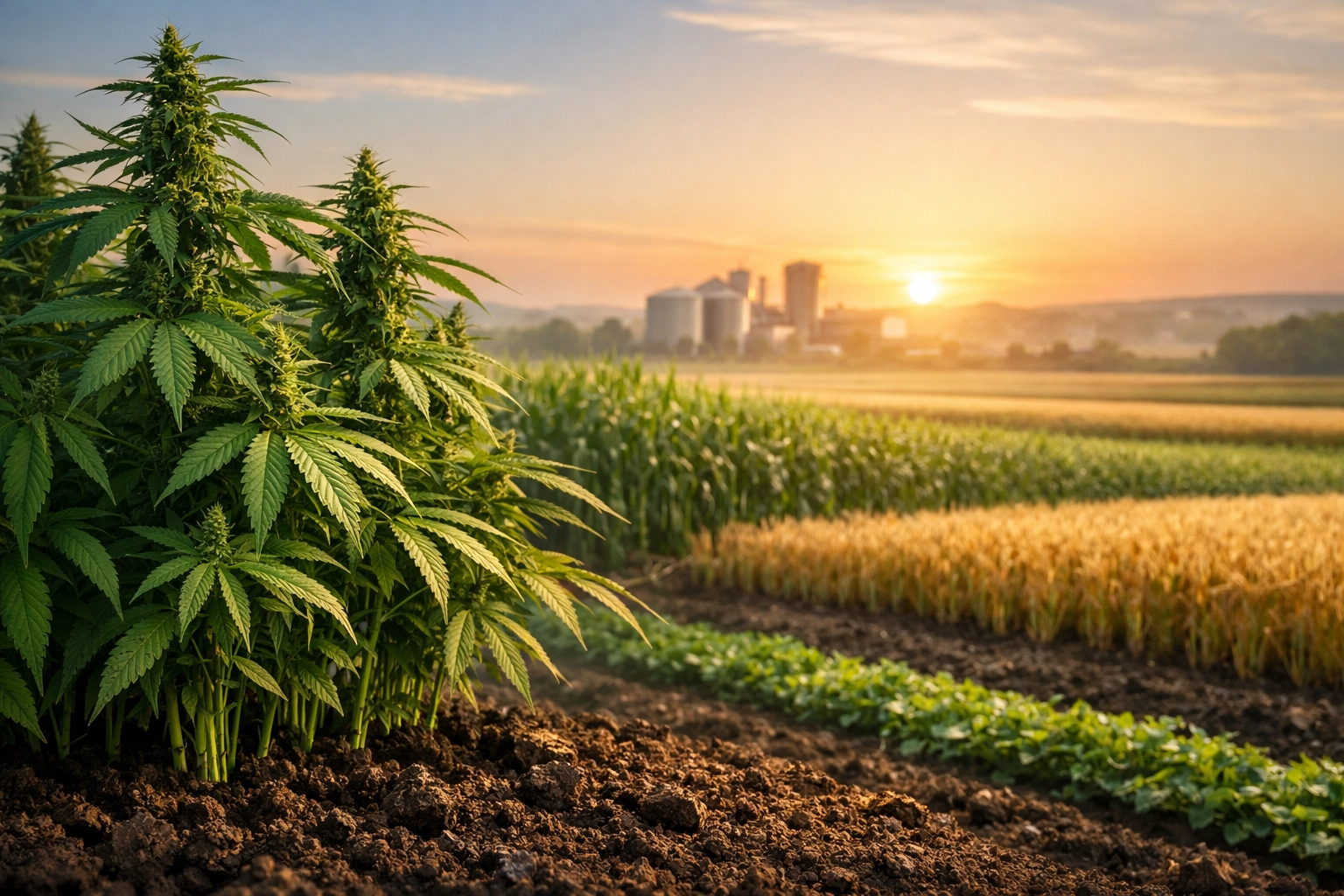
Industrial Hemp in
Crop Rotations,
Soil & Biomass Markets
A practical, farm-focused guide to growing industrial hemp — covering variety selection, agronomy, soil benefits, harvesting, licensing requirements, and realistic pathways to fiber, hurd, grain, and biomass markets. Built for growers, not advocates.
Hemp as a Working Farm Crop — What the Data Actually Shows
Industrial hemp has been cultivated for thousands of years, but its modern agricultural potential — as a rotation crop, soil improver, and multi-market fiber and grain producer — is only now being seriously evaluated at scale. For arable farmers, hemp offers a genuinely interesting break crop option, with lower input costs than most alternatives and real benefits for soil structure.
The key distinction that drives every agricultural decision is what you want from the crop. Hemp grown for bast fiber is managed very differently from hemp grown for grain (seed), and dual-purpose varieties sit in between. Each has different agronomy, different harvesting requirements, and sells into different markets.
HempFabrica’s position: We cover hemp agriculture honestly for farmers and growers making real decisions. The soil and rotation benefits are genuine. The market risks are also real. We say both clearly — and we flag the single most important rule: never grow hemp without a confirmed offtake agreement.
This guide covers everything a farmer or agronomist needs to evaluate hemp: variety types and selection criteria, full agronomy from establishment to harvest, the rotation and soil improvement case, retting and harvesting methods, market pathways with realistic pricing, and licensing requirements by region.
Choosing the Right Hemp Variety for Your Farm
The single most important agricultural decision. Your variety determines your market, your agronomy, and your harvesting approach — get it right before anything else.
Long Fiber & Dual-Fiber Hemp
Bred for maximum bast fiber production. Tall, high stem density, harvested before or at flowering for the longest fiber quality. Used in textiles, industrial composites, insulation, and hempcrete production.
Key varieties: Fedora 17, Futura 75, Félina 32, USO 31. All EU-registered and compliant with THC limits.
Grain & Oilseed Hemp
Shorter, earlier-maturing varieties bred for seed yield. Harvested at seed maturity with a combine harvester. Seed used for hemp oil, protein powder, food ingredients, and animal feed. Fiber quality is secondary.
Key varieties: Finola (Finland), CFX-2 (Canada), Hlesia, Bialobrzeskie. Finola is the most widely used grain variety globally.
Dual-Purpose Hemp
A compromise between fiber and grain output — intermediate height, harvested for seed first with remaining straw either left, baled, or retted for fiber. Increasingly popular where local fiber markets are underdeveloped.
Key varieties: Carmagnola, Asso, KC Dora, Santhica 27. Allows revenue diversification but requires more complex harvesting logistics.
Critical variety rule: Only grow EU-registered or nationally approved varieties. Growing unapproved varieties — even accidentally — can result in crop destruction orders and licence revocation. Always source certified seed from reputable suppliers and check your national approved variety list before ordering.
Hemp Agronomy: Soil, Sowing & Nutrition
Hemp is often described as easy to grow — and in good conditions it is. But getting establishment right is the critical first step. Here’s what the agronomy actually requires.
Soil & Site Requirements
Relative importance — hemp’s tolerance profile
Nutrition Requirements
Typical requirements for fiber crop (kg/ha)
Key Establishment Requirements
- Seedbed preparation Fine, firm, and level seedbed — hemp seed is small and needs good soil contact. Aim for a consolidated tilth to a depth of 5–8cm. Deep ploughing before sowing helps reduce compaction and improve drainage.
- Sowing depth 2–3cm for fiber varieties in well-prepared seedbeds. Shallower is generally better — sowing too deep reduces germination rate significantly. Target soil temperature: minimum 8°C, ideally 10–12°C.
- Sowing date (Northern Hemisphere) Late April to mid-May for fiber varieties. Earlier sowing encourages longer vegetative growth and fiber yield; later sowing risks late autumn weather affecting retting. Grain varieties can be sown later.
- Herbicide options are very limited Very few herbicides are approved for use on hemp in most jurisdictions. Weed control relies almost entirely on hemp’s rapid canopy closure — which it achieves well in well-prepared seedbeds. Pre-emergence mechanical weeding is an option for organic systems.
- No pesticide need typical Hemp has few pest vulnerabilities and its dense canopy suppresses most weed competition after the first 4–6 weeks. This is one of its significant input cost advantages over OSR and other break crops.
Hemp Growing Calendar
A typical Northern Hemisphere fiber hemp growing season — adjust by 6 months for Southern Hemisphere operations.
THC sampling window: In most jurisdictions, licensed hemp growers are required to submit plant samples for THC testing during a specific window — typically when plants are in flowering (late July to August in the UK and EU). Miss this window and you may face compliance issues. Confirm the exact requirements with your licensing authority before sowing.
Hemp in Crop Rotation
Hemp’s most compelling agronomic argument is as a break crop in cereal-dominated rotations. Here’s how to think about the rotation logic.
Example 4-Year Arable Rotation with Hemp
Why Hemp Works as a Break Crop
- Disease interruption Hemp is not a host for common arable diseases (take-all, septoria, clubroot) — making it an effective break from cereal and brassica disease cycles.
- Weed suppression Hemp’s rapid establishment and dense canopy shade out most annual weeds by week 5–6 — reducing the weed seedbank in the rotation without herbicide use.
- Residual nitrogen Hemp roots and leaf litter contribute organic nitrogen to the following crop — particularly beneficial for the wheat or barley that follows.
- Low input cost No fungicides, typically no pesticides, and lower herbicide spend than OSR make hemp genuinely cheaper to grow in terms of agrochemical inputs.
Hemp vs OSR as a Break Crop
Hemp’s Soil Health Benefits
Beyond the crop itself, hemp has a documented positive impact on the soil it’s grown in — a genuine long-term benefit for the farm system.
- Deep taproot system improves soil structure Hemp develops a strong taproot that can penetrate to 1.5–2m depth in suitable soils. This breaks up compaction layers, improves drainage channels, and creates macropores that benefit subsequent crops. The effect is particularly pronounced in silty or loamy soils.
- High organic matter contribution Hemp sheds a substantial volume of leaves during its growing season — this leaf litter decomposes rapidly and contributes to soil organic matter. Combined with root biomass, the organic matter contribution from one hemp crop is estimated at 1.5–3 t/ha.
- Phytoremediation potential Hemp is well-documented as a phytoremediator — capable of extracting heavy metals (cadmium, lead, nickel) from contaminated soils. This is relevant for degraded agricultural land or brownfield rehabilitation. Note: crops grown on contaminated land cannot enter food or feed supply chains.
- Mycorrhizal associations Hemp supports mycorrhizal fungal networks in the soil — the beneficial root-fungal associations that underpin healthy soil biology. These persist to benefit subsequent crops in the rotation.
- Reduced erosion risk Hemp’s rapid canopy establishment means the soil is covered and protected from erosion early in the season. The dense root system also holds topsoil through autumn rains during and after harvest.
Realistic caveat: Soil health benefits are real but their magnitude varies significantly by soil type, management history, and what follows hemp in the rotation. Don’t over-rely on hemp as a soil remedy for severely degraded or very heavy clay soils without appropriate cultivation input — hemp establishes poorly in waterlogged or highly compacted conditions.
Cutting, Retting & Baling Hemp
Harvesting hemp correctly is the most technically demanding part of the growing process. The method you use depends entirely on your market — fiber quality requirements differ significantly.
Cutting at the Right Stage
Fiber varieties are cut at or just after flowering — before seeds set — to maximise long fiber quality. Cutting too late (at seed maturity) reduces fiber fineness and length significantly. Grain varieties are harvested at seed maturity using a standard combine harvester with header adjustments.
Equipment: Hemp mowers and swathers with conditioner rolls work best for fiber crops. Standard disc mowers can be used but may cause excessive stem breakage. The stem should be crimped or crushed to accelerate retting.
Field Retting
Retting is the biological separation of bast fiber from the woody core — achieved by leaving cut stems on the field for microbial activity to degrade the pectin bonding the fiber. Duration: typically 3–6 weeks depending on temperature and moisture.
- Cut stems are laid in swaths in the field immediately after cutting
- Regular turning (every 1–2 weeks) ensures even retting across the swath
- Target: even, medium-brown color across the stem — not too light (under-retted) or too dark/black (over-retted and degraded)
- Weather dependent — rain accelerates retting; dry periods slow it significantly
- Over-retted straw loses fiber strength — monitor closely in wet autumns
Baling & Moisture Management
Once retting is complete and the straw has dried to below 15% moisture content, it can be baled for transport. Both round and square bales are used — square bales are preferred by many processors for storage density and handling efficiency.
Critical moisture rule: Never bale above 18% moisture — straw baled wet will generate heat, create mould, and become unacceptable to most fiber processors. Use a moisture meter before baling begins.
Storage & Delivery
Bales should be stored under cover or on a well-drained hard standing — hemp straw absorbs moisture readily. Confirm delivery timing, bale specifications, and moisture tolerances with your processor before harvest begins.
Most processors will specify bale weight, tie material, dimensions, and maximum moisture content in their supply contracts. Read these carefully and plan your logistics accordingly.
Water retting (alternative): Some specialist textile fiber producers require water-retted hemp — where cut stems are submerged in ponds or tanks for controlled bacterial retting. This produces finer, longer fiber suitable for premium textile applications but requires significant infrastructure and water management. Most commercial fiber hemp is field-retted.
Hemp Market Pathways — Prices & Maturity
The most important pre-growing decision. Every pathway has different market maturity, different price ranges, and different processor requirements. Always have a confirmed contract before sowing.
Hemp Hurd / Shiv
The woody core separated from bast fiber during decortication. Primary market is hempcrete manufacturers and insulation board producers. Demand is growing but supply chain infrastructure varies significantly by region.
- Sold by weight — typically per tonne delivered to processor
- Quality criteria: consistent particle size, low dust, low moisture
- Usually a co-product when selling into fiber contracts
Bast Fiber
The long outer fiber — the highest-value output from a fiber hemp crop. Used in industrial textiles, composites, insulation batts, and geotextiles. Requires decortication at a processor before sale into end markets.
- Farmer typically sells whole straw bales to decorticator
- End fiber price much higher but processor margin applies
- Long fiber commands significant premium over short/cottonised fiber
Hemp Grain / Seed
Harvested using a combine from grain or dual-purpose varieties. Used for hemp oil, hulled hemp hearts, protein powder, and animal feed. The most mature market in terms of food industry infrastructure and demand.
- Cleaned and dried seed — typically 8–10% moisture for storage
- Premium for food-grade vs feed-grade — confirm specification early
- Combine harvest familiar to most arable farmers
Biomass for Energy
Hemp whole straw or hurds can be used as a biomass fuel in energy applications. Lowest-value pathway — typically only viable where energy contracts exist locally or where straw quality is too poor for fiber markets.
- Calorific value comparable to other agricultural biomass fuels
- Local energy contracts essential — transport cost kills margins
- Consider only as a fallback if fiber/grain markets unavailable
Hemp Hurd as Animal Bedding
A well-established secondary market for hemp hurd — particularly in equestrian bedding where hemp’s high absorbency, low dust, and easy mucking out are valued. Often more accessible to smaller growers than fiber processing contracts.
- Requires decortication — either by processor or on-farm if equipment available
- Premium for consistent particle size and very low moisture
- Increasingly competing with wood pellet bedding on price
Hemp Seed for Planting
Certified seed production for registered hemp varieties can command significant premiums but requires quality management, isolation distances, and certification body approval. A specialist route not suitable for all growers.
- Must grow registered variety under seed multiplication scheme
- Strict isolation distances (300–500m) required from other hemp crops
- Requires certification inspection and official testing
The golden rule — confirmed contract before sowing: Hemp market infrastructure is thinner than conventional arable markets. Never commit to growing a hemp crop without a signed offtake agreement with a named processor or buyer. Spot markets for hemp straw and hurd are limited in most regions — you could be left with a full crop and no buyer. The agronomic case is strong; the market risk is real.
Licensing Industrial Hemp by Region
Licensing requirements vary significantly by country. This is a practical overview — always verify current requirements with your national authority before applying.
Growers must obtain an Industrial Hemp Licence from the Home Office (England, Wales, Scotland) or PSNI (Northern Ireland). Apply at least 3 months before sowing. Only approved varieties permitted. THC testing required during flowering. Seed must be sourced from licensed supplier.
EU-wide framework under the Common Agricultural Policy — member states implement via national schemes. Only EU-registered varieties on the Common Catalogue permitted. THC limit raised to 0.3% in 2024. Area declarations required. CAP payments may be available for hemp crops in some member states.
Regulated under the 2018 Farm Bill. Growers must be licensed through their state’s USDA-approved hemp programme or directly through USDA. Each state has its own application process, fees, and inspection requirements. THC testing by approved laboratory required. Crop destruction mandatory if THC exceeds 0.3%.
One of the most mature hemp licensing frameworks globally. Licensed through Health Canada under the Industrial Hemp Regulations. Only approved cultivars permitted (Health Canada list). Annual registration, site inspection, and THC testing required. Canada has extensive commercial infrastructure for grain and fiber hemp.
State and territory licensing — regulations differ between Australian states. Hemp food products were legalised in 2017. Growers apply to state agricultural authority; requirements vary. The industry is growing, particularly in Victoria and Tasmania which have more developed processor networks.
Industrial hemp is now legal in over 40 countries, including India (state-by-state), China (major global producer), Switzerland, and much of Latin America. Regulatory maturity varies widely. Always consult your national authority — do not rely on generic advice for local licensing requirements.
Hemp Agriculture — Pros & Real Risks
We don’t oversell hemp. Here’s a frank assessment of what makes it worth considering — and what could go wrong.
Industrial Hemp Agriculture FAQ
Straight answers to the questions growers and agronomists ask most often.
Do I need a licence to grow industrial hemp?
Yes — in almost every jurisdiction worldwide. Hemp is still classified as a controlled substance in most countries despite industrial varieties having negligible THC. Licensing requirements vary significantly: in the UK you apply to the Home Office; in the US through your state’s USDA-approved hemp programme; in the EU through your national agricultural authority.
Apply well in advance of your planned sowing date — processing times vary from 4–12 weeks and some authorities have annual application windows. Growing without a licence will result in crop destruction.
What happens if my crop tests above the THC limit?
In most jurisdictions, if your crop exceeds the legal THC threshold (0.3% in the UK, EU, USA, and Canada), the entire crop must be destroyed — you will not be able to harvest it. You will also need to notify your licensing authority immediately. Depending on the circumstances and your jurisdiction, your licence may or may not be affected for future growing seasons.
THC accumulation risk is higher in hot, dry summers and varies by variety — choosing certified low-THC varieties from reputable suppliers is the best mitigation. Do not rely on seed vendor claims alone; check current approved variety lists with your licensing authority.
Can I use my existing combine harvester for hemp?
For grain/seed varieties, yes — with some modifications. Header adjustments are typically needed to handle the taller plant canopy, and stripping headers can improve grain recovery. For fiber varieties, a standard combine is not appropriate. You will need a hemp mower/swather with conditioning rolls to cut and lay the crop for field retting — most farmers either hire specialist contractors or purchase dedicated kit.
How do I find a hemp fiber or hurd processor near me?
In the UK, the Hemp Building Association and British Hemp Alliance maintain lists of processors and can point growers toward active buying programmes. In the EU, national hemp associations (Chanvre Info in France, BIoHanf in Germany etc.) and the European Industrial Hemp Association (EIHA) are good starting points. In North America, the Vote Hemp and National Hemp Association maintain processor directories.
Your seed supplier is also a useful first contact — most work with processors and can make introductions. Never buy seed without first having a processor conversation.
Is hemp a good fit for organic farming systems?
Hemp’s agrochemical profile — typically no pesticides, no herbicides after canopy close — makes it inherently compatible with organic systems. However, certified organic seed can be difficult to source in some regions, and approved inputs for the limited situations where intervention is needed are even more limited than in conventional systems. Check with your organic certification body before growing hemp as part of an organic rotation.
What are realistic gross margins for hemp in the UK?
Gross margins vary significantly by variety, yield, contract price, and whether you sell straw or both straw and grain. A typical fiber contract at £70–90/t delivered, with 5–7t/ha straw yield, gives a gross output of £350–630/ha before harvesting and transport costs. After those costs (typically £150–250/ha depending on contractor), gross margins of £150–400/ha are achievable — broadly comparable to winter wheat in an average year.
The key variables are yield consistency (hemp can fail badly in poor establishment years) and transport cost to the processor. Proximity to a processor matters enormously for profitability.
Ready to Evaluate Hemp for Your Farm?
Use our free comparison tool and checklist, or explore other sector guides for context.
Content Disclosure: HempFabrica is an independent, reader-supported resource. Some links on this page may be affiliate or partner links. Pricing data is indicative and based on publicly available market information for 2025–2026 — verify with current processors and suppliers before making commitments. Licensing information is a practical overview only — always verify current requirements with your national regulatory authority. This page was last reviewed and updated in 2026.